Detailed Introduction to Yjlv, Yjly, Zc-Yjly Low-Voltage Power Cables
I. From the Perspective of the Product Itself
(1) Specification Parameters
The three types of low-voltage
Power Cables, Yjlv, Yjly, and Zc-Yjly, all have the specification of 3×150, which is an important common feature in their structure. Among them, "3" means the cable contains 3 conductors, and "150" indicates that the cross-sectional area of each conductor is 150mm².
In terms of current-carrying capacity, these three types of cables, relying on the 150mm² conductor cross-sectional area, can reach a current-carrying capacity of 180-220A, which can stably meet the medium and high-power power transmission needs. This current-carrying capacity range enables them to provide stable power supply for high-power equipment such as large industrial motors and shopping mall central air conditioners. In industrial production, large industrial motors often need continuous and stable large current support to operate normally, and the current-carrying capacity of these cables can just match their needs; in commercial places, shopping mall central air conditioners have high power and high requirements for power transmission, and these three types of cables can also be competent for their power supply tasks.
In addition to the cross-sectional area, the purity of the conductor is also an important parameter. The conductors of these three types of cables are made of high-purity pure copper with a purity of more than 99.9%. Such high purity ensures the excellent conductivity of the conductor, with a conductivity of up to 58MS/m, which is far superior to alloy conductors. High conductivity means that line losses will be significantly reduced during current transmission, thereby reducing energy consumption costs in long-term operation, which is of great economic significance for scenarios requiring long-term stable power supply.
In terms of the insulation layer, the XLPE (cross-linked polyethylene) insulation layer has excellent performance parameters after warm water cross-linking treatment. Its temperature resistance level reaches 90℃, and it can maintain stable insulation performance in the environment of -40℃ to 90℃, which enables the cable to work reliably under different temperature conditions, whether in cold northern regions or high-temperature industrial workshops. The insulation resistance is ≥1000MΩ·km, and the breakdown field strength is ≥20kV/mm. These parameters ensure that the insulation layer can effectively prevent current leakage and provide a strong guarantee for electrical safety. At the same time, the XLPE insulation layer has a tensile strength of ≥12MPa and an elongation at break of ≥150%, with excellent mechanical strength, which can resist stretching and extrusion during laying and reduce failures caused by mechanical damage.
Different types of cables also have their own specification parameters in terms of sheaths. The
PVC Sheath of Yjlv has an oxygen index of ≥30, which indicates that it has certain flame retardant performance. At the same time, its acid and alkali resistance meets the GB/T 2951.5 standard, ensuring stable operation in corrosive environments. The polyethylene sheath of Yjly has an elongation at break of ≥300%, indicating excellent
Flexibility, and the minimum bending radius is only 6 times the outer diameter of the cable, which provides convenience for laying in narrow spaces and scenarios requiring frequent bending. The polyethylene sheath of Zc-Yjly has added flame retardants and passed the bundle combustion test of GB/T 18380.3 standard, with a flame spread length of ≤1.5m and no ignition of filter paper by burning drips. The clear parameter indicators demonstrate its excellent flame retardant performance.
(2) Characteristic Uses
Due to their respective performance characteristics, Yjlv, Yjly, and Zc-Yjly cables have characteristic uses in different scenarios.
Yjlv cable, relying on the good acid and alkali resistance and economy of the PVC sheath, performs prominently in humid and corrosive environments such as chemical workshops. Chemical workshops often have various acid and alkali gases and liquids, which are highly corrosive to cables. However, the PVC sheath of Yjlv cable can resist these corrosions and can maintain stable performance for more than 5 years. At the same time, its cost is 15%-20% lower than that of polyethylene. For large chemical enterprises, it can effectively reduce procurement costs on the premise of meeting the use requirements, so it is widely used in the power distribution system of the chemical industry.
The polyethylene sheath of Yjly cable has excellent flexibility, with an elongation at break of ≥300% and a minimum bending radius of only 6 times the outer diameter of the cable, which makes it particularly suitable for wiring scenarios that require frequent bending, such as building interlayers and equipment interiors. In building construction, the space in the building interlayer is narrow, and the cable needs to be bent many times during wiring. Yjly cable can easily cope with this complex laying environment, ensuring smooth and safe wiring. In large equipment, the line layout is compact, and the flexibility of Yjly cable enables it to shuttle flexibly inside the equipment to meet the power connection needs of the equipment.
Zc-Yjly cable, due to its flame retardant properties, can significantly improve the safety factor in places with high fire protection requirements such as high-rise buildings and hospitals. Once a fire breaks out in a high-rise building, the fire spreads rapidly with serious consequences. Zc-Yjly cable has passed the bundle combustion test of GB/T 18380.3 standard, with a flame spread length of ≤1.5m and no ignition of filter paper by burning drips, which can effectively delay the spread of the fire and gain valuable time for personnel evacuation and fire rescue. As a special place, hospitals are crowded with a large number of precision instruments and have extremely high fire protection requirements. The flame retardant performance of Zc-Yjly cable provides an important guarantee for the safety of the power system in hospitals, so it is widely used in the power distribution lines of hospitals.
In addition, these three types of cables, as low-voltage power cables, are widely used in scenarios such as the main lines of industrial power distribution systems, the power main lines of commercial complexes, and the street lamp power supply networks of municipal roads. In the industrial power distribution system, they serve as main lines and undertake the important task of transmitting power from substations to various production workshops; in commercial complexes, the power main lines need to provide power for many shops, entertainment facilities, etc., and these three types of cables can meet their needs for large current transmission; in the street lamp power supply network of municipal roads, they can work stably in outdoor environments to ensure the normal lighting of street lamps.
(3) Material and Style
Material
These three types of cables have both commonalities and differences in materials.
In terms of conductors, all use high-purity pure copper with a purity of more than 99.9%. Pure copper has excellent conductivity, with a conductivity of up to 58MS/m, which can effectively reduce losses during current transmission and ensure the efficiency of power transmission. At the same time, pure copper has good ductility and toughness, which is convenient for processing into various specifications of conductors, and is not easy to break during laying, able to adapt to different installation environments.
The insulation layer uniformly uses XLPE (cross-linked polyethylene), and its performance has been greatly improved after warm water cross-linking treatment. The XLPE molecules form a three-dimensional network structure, which makes it have excellent heat resistance, insulation, and mechanical strength. In terms of heat resistance, the temperature resistance level reaches 90℃, and it can maintain stable performance in the environment of -40℃ to 90℃; in terms of insulation, the insulation resistance is ≥1000MΩ·km, and the breakdown field strength is ≥20kV/mm, effectively preventing current leakage; in terms of mechanical strength, the tensile strength is ≥12MPa, and the elongation at break is ≥150%, able to resist stretching and extrusion during laying.
The sheath material is the main difference between the three types of cables. Yjlv uses a PVC (polyvinyl chloride) sheath, which has good corrosion resistance, wear resistance, certain flame retardancy, and low cost. Yjly uses polyethylene as the sheath, which has excellent flexibility, low-temperature resistance, and chemical stability, but its flame retardancy is relatively poor. Zc-Yjly adds flame retardants to the polyethylene sheath, which, while maintaining the advantages of polyethylene such as flexibility, endows the cable with good flame retardant performance.
Style
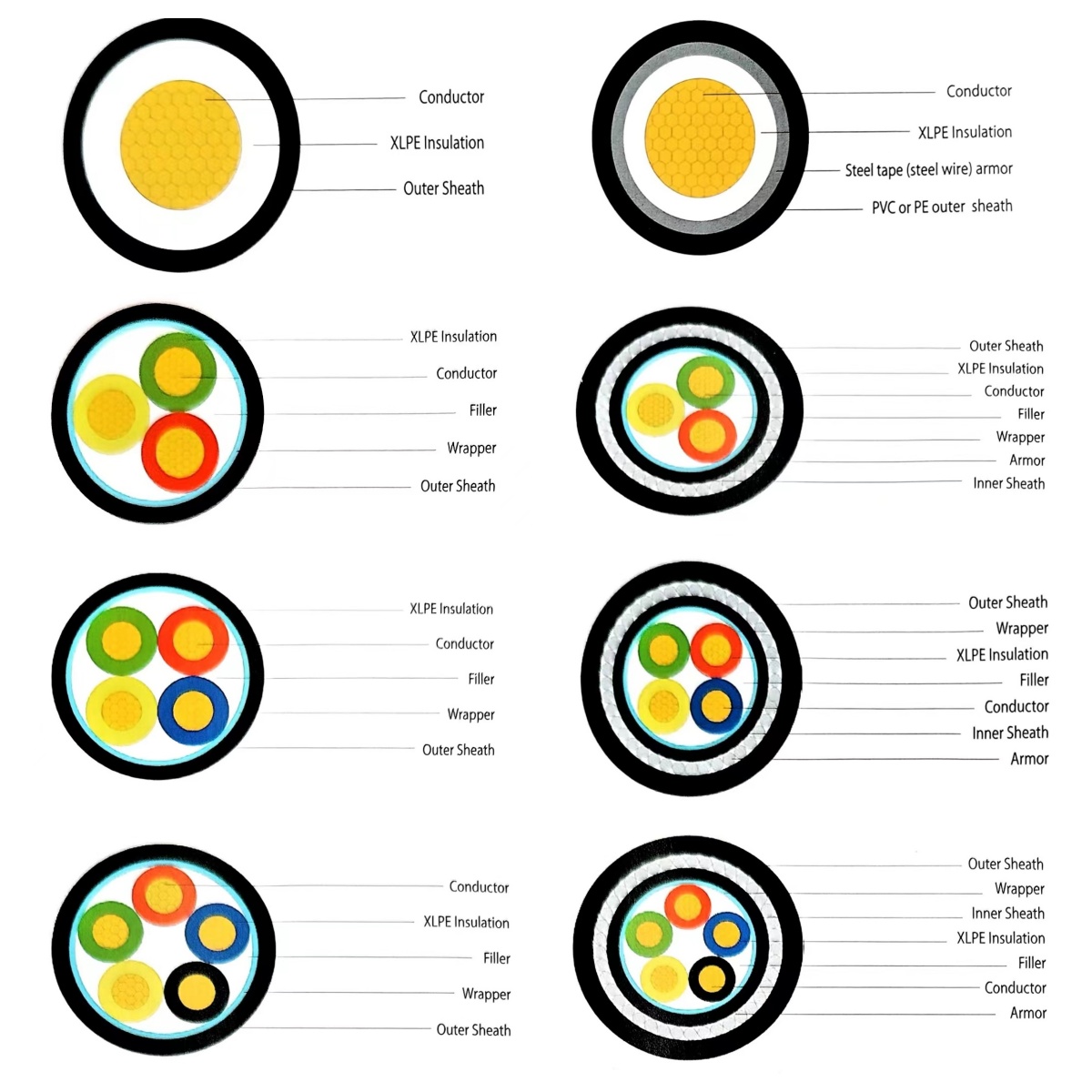
In terms of appearance style, these three types of cables have similar overall structures, all composed of conductors, insulation layers, and sheath layers, presenting a cylindrical long strip shape.
In terms of color, it is usually set according to different usage scenarios and standards. Generally speaking, the sheath color of cables is mostly black, which has good weather resistance and can reduce the aging effect of direct sunlight on the sheath, suitable for outdoor laying. In some special scenarios, there may also be sheaths of other colors to facilitate the distinction of cables with different functions, making installation and maintenance convenient.
In terms of structural style, all are
Multi-Core cables, with 3 conductors twisted together, and the outside is wrapped with an insulation layer and a sheath layer. This twisted structure makes the cable more flexible, easy to bend and lay, and can also reduce electromagnetic interference during cable transmission. In addition, the outer diameter of the cable depends on the specification. The outer diameter of the 3×150 specification cable is relatively large, which can accommodate the conductor with a cross-sectional area of 150mm², as well as the corresponding insulation layer and sheath layer, ensuring the overall strength and performance of the cable.
(4) Production Process
The production processes of Yjlv, Yjly, and Zc-Yjly cables have similarities and differences due to different sheath materials.
Common Production Processes
(1) Conductor Production: First, high-purity copper raw materials are smelted to remove impurities and improve the purity of copper. Then, the copper liquid is cast into copper rods through continuous casting process, and the quality of copper rods directly affects the performance of subsequent conductors. Next, the copper rod is drawn into
Copper Wires with the required diameter by wire drawing process. During the wire drawing process, it is necessary to control the wire drawing speed and temperature to ensure the dimensional accuracy and mechanical properties of the copper wires. Finally, multiple copper wires are twisted together to form a conductor with a cross-sectional area of 150mm². Twisting can improve the flexibility and filling coefficient of the conductor.
(2) Insulation Layer Extrusion and Cross-linking: The produced conductor is cleaned and dried to remove oil and impurities on the surface. Then, the XLPE
Insulation Material is wrapped around the conductor by extrusion process. During the extrusion process, it is necessary to accurately control the temperature, pressure, and speed of the extruder to ensure that the insulation layer has uniform thickness, smooth surface, and is closely combined with the conductor. After extrusion, the insulation layer is subjected to warm water cross-linking treatment. The cable is put into warm water, and under certain temperature and pressure conditions, the XLPE molecules undergo a cross-linking reaction to form a three-dimensional network structure, thereby improving the heat resistance, insulation, and mechanical strength of the insulation layer.
Different Production Processes (Sheath Production)
(1) Yjlv Cable: After the insulation layer is processed, the extrusion process is used to wrap the PVC sheath around the insulation layer. First, the PVC raw materials are mixed and plasticized, and additives such as stabilizers and plasticizers are added to improve the performance of PVC. Then, the plasticized PVC material is extruded to the outer layer of the cable insulation layer through an extruder, and the extrusion process parameters are controlled to ensure that the sheath has uniform thickness and flat surface. After extrusion, the cable is cooled and shaped to solidify the sheath.
(2) Yjly Cable: Polyethylene material is used for sheath production. Polyethylene particles are added to the extruder, heated and melted, and then extruded into a polyethylene sheath on the outer layer of the insulation layer through an extrusion die. During the extrusion process, it is necessary to control the temperature and speed to ensure that the sheath is closely combined with the insulation layer and has uniform thickness. Due to the good flexibility of polyethylene, the cooling and shaping process after extrusion is relatively simple, usually using air cooling or water cooling.
(3) Zc-Yjly Cable: Its sheath production adds flame retardants to the polyethylene material. First, polyethylene particles and flame retardants are mixed uniformly in a certain proportion to ensure that the flame retardants are evenly dispersed in polyethylene. Then, the mixed material is added to the extruder for melting and extrusion to form a flame-retardant polyethylene sheath on the outer layer of the insulation layer. The control of extrusion process parameters is similar to that of Yjly cable, but it is necessary to pay attention to the influence of flame retardant addition on material fluidity and appropriately adjust the process parameters to ensure the sheath quality.
Finished Product Inspection: After production, the three types of cables need to undergo strict inspection. The inspection items include the DC resistance of the conductor, the insulation resistance and breakdown field strength of the insulation layer, the thickness and mechanical properties of the sheath, etc. For Zc-Yjly cables, flame retardant performance tests are also required to ensure that they meet relevant standards. Only qualified products can leave the factory.
II. From the Perspective of General Product Information
(1) Packaging
The packaging of Yjlv, Yjly, and Zc-Yjly low-voltage power cables focuses on protecting the quality and performance of the cables during transportation and storage.
For coiled cables, cable reels are usually used for packaging. There are two types of cable reels: wooden and iron. Wooden cable reels have low cost and light weight, suitable for short-distance transportation and packaging of small batches of cables; iron cable reels have high strength and large load-bearing capacity, suitable for long-distance transportation and packaging of large batches of cables, which can better protect cables from extrusion and collision.
When the cable is wound on the cable reel, it needs to be arranged neatly to avoid twisting and knotting, so as to prevent damage to the cable insulation layer and sheath layer. After winding, a layer of plastic film is wrapped around the outer layer of the cable. The plastic film has good moisture-proof and dust-proof performance, which can protect the cable from moisture and dust erosion. For cables that need to be stored for a long time, a layer of linen or canvas is wrapped around the outer layer of the plastic film to further enhance the protective effect and prevent the cable from direct sunlight and mechanical damage.
A label is fixed on the side of the cable reel, which details the cable's model, specification, length,
Conductor Material, insulation material, production date, manufacturer, and other information, facilitating customers' identification and verification during receipt and storage. At the same time, the label also indicates some precautions, such as "Do not press heavily" and "Moisture-proof and sun-proof".
For small-length cables, reel or bundle packaging may be used. Reel packaging is similar to cable reels but smaller in size, easy to carry and transport; bundle packaging is to neatly bundle the cables into bundles and wrap them with plastic film, suitable for temporary use or small batch procurement.
(2) Transportation
The transportation of Yjlv, Yjly, and Zc-Yjly cables needs to strictly follow relevant regulations to ensure that the cables arrive at the destination safely.
Transportation Methods: According to the transportation distance and quantity, different transportation methods can be selected. Short-distance transportation generally adopts road transportation, using trucks for loading. Road transportation has high flexibility and can directly deliver the cables to the customer's designated location, suitable for small batch and urgent transportation needs. For long-distance transportation, railway transportation or waterway transportation can be chosen. Railway transportation has large capacity, fast speed, and good stability, suitable for long-distance transportation of large quantities of cables; waterway transportation has low cost, suitable for transporting large and heavy cables, but the transportation time is relatively long.
Transportation Precautions: When loading cables, it is necessary to ensure that the cable reels are placed stably and fixed firmly to avoid tilting, rolling, or collision during transportation. For wooden cable reels, attention should be paid to avoiding damage caused by excessive extrusion; for iron cable reels, rust-proof treatment should be done to avoid rusting due to moisture during transportation.
During transportation, cables should be prevented from direct sunlight and rain. Direct sunlight will cause aging of the cable sheath layer, affecting its service life; rain may make the cable damp, reducing its insulation performance. Therefore, it is necessary to cover the cables with waterproof cloth to ensure that the cables are in a dry and cool environment.
When loading and unloading cables, professional hoisting equipment such as cranes and forklifts must be used. It is strictly forbidden to carry them manually to avoid damage to the cable reels or cable breakage. When hoisting, appropriate lifting points should be selected to ensure that the cable reels are evenly stressed and avoid deformation of the cable reels.
During transportation, traffic rules should be observed, transportation routes and time should be reasonably arranged, and severe weather and traffic jam sections should be avoided to ensure transportation safety and on-time delivery.
(3) Delivery
The delivery process of the three types of cables is standardized and orderly to ensure that customers can receive qualified products in a timely manner.
Order Confirmation: After a customer places an order, the sales staff will communicate with the customer in a timely manner to confirm the cable's model, specification, quantity, delivery date, delivery location, and other information to ensure that the order information is accurate. At the same time, the sales staff will feedback the inventory status or production progress to the customer, allowing the customer to understand the preparation status of the product.
Stock Preparation and Inspection: According to the order requirements, warehouse staff will retrieve the corresponding cables from the inventory or notify the production department to arrange production. Before delivery, quality inspectors will conduct sampling inspections on the cables to check whether the appearance, size, performance, etc. of the cables meet the order requirements and relevant standards. Only after passing the inspection can delivery be arranged.
Packaging and Labeling: The inspected cables are packaged in accordance with the specified packaging methods, and clear labels are marked on the packaging, including customer name, order number, product model, specification, quantity, and other information, so that customers can check when receiving the goods.
Logistics Arrangement: According to the customer's delivery location and transportation requirements, a
suitable logistics company is selected, and a transportation contract is signed with the logistics company to clarify the rights and obligations of both parties. The logistics company arranges vehicles to pick up the goods from the warehouse. Warehouse staff and logistics company personnel jointly check the quantity and information of the cables, and after confirmation, go through the handover procedures and fill in the freight documents.
Delivery Notification: After the cables are shipped, the sales staff will promptly inform the customer of the delivery information, including the name of the logistics company, waybill number, estimated arrival time, etc., to facilitate the customer to track the transportation status of the goods. At the same time, the sales staff will maintain communication with the customer and promptly handle any problems that may arise during transportation.
(4) Samples
To allow customers to better understand the performance and quality of Yjlv, Yjly, and Zc-Yjly cables, the enterprise provides sample services.
Sample Application: Customers can apply for samples from the enterprise by phone, email, online platform, etc., indicating the model, specification, quantity and other information of the required samples. The enterprise's sales staff will contact the customer within 24 hours after receiving the application to confirm the sample details and delivery address.
Sample Preparation: Samples are prepared in strict accordance with the production process of formal products to ensure that the performance and quality of the samples are consistent with bulk products. The production department will select raw materials that meet the specifications for production according to customer needs, and produce samples through conductor production, insulation layer extrusion and cross-linking, sheath production and other links.
Sample Inspection: After the samples are produced, the quality inspection department will conduct a comprehensive inspection on them, including appearance, size, performance and other items, to ensure that the samples meet relevant standards and customer requirements.
Sample Delivery: The qualified samples will be simply packaged with sample labels attached, indicating the model, specification, production batch number and other information of the samples. Then they will be sent to customers by express. The sales staff will inform the customer of the express tracking number to facilitate the customer to check the delivery progress of the samples.
Sample Fees: The cost of samples is usually borne by the customer, including the production cost and transportation cost of the samples. If the customer subsequently signs a bulk order, the enterprise will reduce or refund the sample fee as appropriate according to the order amount, which can be negotiated with the sales staff.
(5) After-sales Service
The enterprise provides perfect after-sales service for Yjlv, Yjly, and Zc-Yjly cables to protect the legitimate rights and interests of customers.
Quality Assurance: The enterprise promises that the product quality meets relevant national standards and industry standards, and provides a quality guarantee period of 1-3 years from the date of product delivery. During the quality guarantee period, if the cable cannot be used normally due to its own quality problems, the enterprise will provide free repair or replacement services for the customer.
Technical Support: Customers can contact the enterprise's technical support department at any time if they encounter any technical problems during the installation, use and maintenance of the cable. Technical personnel will provide customers with professional technical guidance through phone, email, video and other means, answer customers' questions and help customers solve practical problems. For complex technical problems, the enterprise can arrange technical personnel to conduct on-site guidance.
Fault Handling: If the cable fails during use, customers can call the after-sales service hotline to report the fault. The after-sales service staff will record the fault situation in detail and arrange professional maintenance personnel to deal with it according to the severity of the fault. For minor faults, maintenance personnel can guide customers to solve them remotely; for major faults, maintenance personnel will rush to the site as soon as possible to carry out inspection, maintenance and replacement work.
Customer Feedback: The enterprise attaches great importance to customers' feedback and has set up special customer feedback channels, such as suggestion boxes and complaint hotlines. Customers can put forward opinions and suggestions on product quality, service attitude, etc. The enterprise will promptly handle and improve the problems reflected by customers, continuously improving product quality and service level.
Return and Exchange Policy: If the received cable has quality problems or does not conform to the order requirements, customers can apply for return or exchange within 7 days after receiving the goods. The enterprise will review the application and, if the situation is true, handle the return or exchange procedures for the customer and bear the corresponding transportation costs. For returns and exchanges due to non-quality problems, customers need to bear the round-trip transportation costs, and the cable must be kept intact without affecting secondary sales.


 English
 Español
 Portugues
 Pусский
 Français
 ไทย
ไทย Türk dili
 Indonesia
 Tiếng Việt



 هاتف
هاتف صندوق البريد