I. From the Perspective of the Product Itself
(1) Specification Parameters
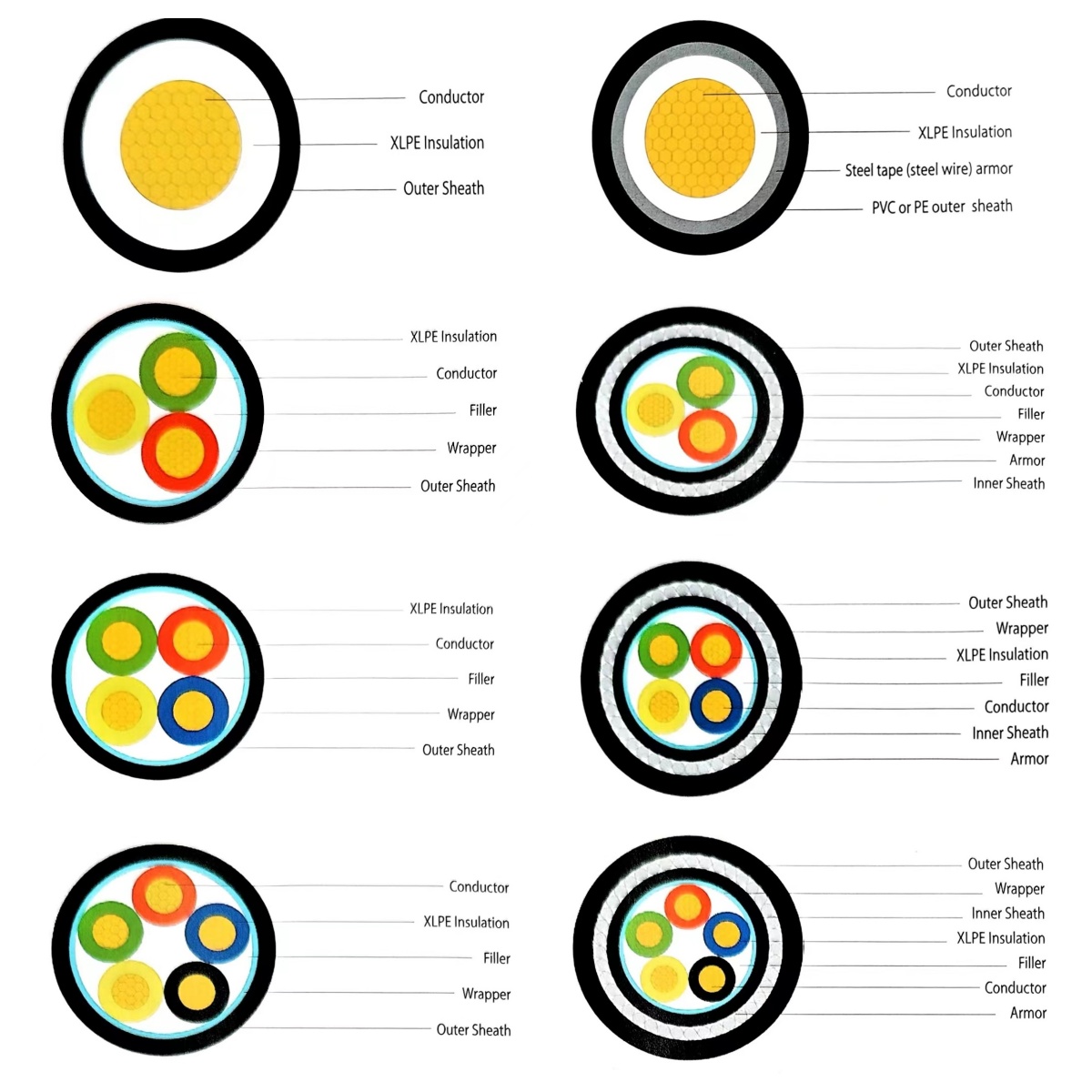
The rated voltage of this cable is fixed at 0.6/1kV, which enables it to be stably applied in low-voltage distribution systems, providing safe and reliable power support for various equipment. In terms of conductor specifications, it covers various common specifications such as 5×25mm², 5×50mm², 5×70mm², and 5×95mm². Among them, for the 5×25mm² cable, each conductor has a cross-sectional area of 25mm², and the overall current-carrying capacity of the 5 conductors combined can reach 80-100A under specific environments; for the 5×50mm² cable, the cross-sectional area of a single conductor is 50mm², and the overall current-carrying capacity is approximately 120-150A; for the 5×
70mm² Cable, the cross-sectional area of a single conductor is 70mm², and the current-carrying capacity is roughly 160-190A; for the 5×95mm² cable, the cross-sectional area of a single conductor is 95mm², and the current-carrying capacity can reach 200-230A. These current-carrying capacity data are obtained under standard ambient temperature (25℃) and specific laying conditions, and the actual use will be affected by factors such as ambient temperature and laying methods.
The DC resistance of the conductor is also one of the important specification parameters. At 20℃, the DC resistance of the 25mm² conductor is not greater than 0.727Ω/km, the 50mm² conductor is not greater than 0.387Ω/km, the 70mm² conductor is not greater than 0.268Ω/km, and the 95mm² conductor is not greater than 0.193Ω/km. The low DC resistance ensures that the energy loss of the cable during current transmission is small, improving the efficiency of power transmission.
The thickness of the insulation layer varies according to the conductor specifications. The insulation layer thickness corresponding to the 25mm² conductor is about 0.8mm, that of the 50mm² is about 1.0mm, that of the 70mm² is about 1.2mm, and that of the 95mm² is about 1.4mm. Sufficient insulation layer thickness can effectively prevent current leakage, ensure the insulation performance of the cable, and avoid the occurrence of faults such as short circuits.
The thickness of the sheath layer also varies with specifications, generally ranging from 1.8-2.2mm. The sheath thickness of the 25mm² cable is about 1.8mm, and as the conductor specification increases, the sheath thickness increases slightly, with the sheath thickness of the 95mm² specification being about 2.2mm. A suitable sheath thickness provides good mechanical protection for the cable, enabling it to resist external wear and extrusion.
In addition, the bending radius of the cable is clearly specified. The static bending radius is not less than 4 times the outer diameter of the cable, and the dynamic bending radius is not less than 10 times the outer diameter of the cable. This parameter ensures that the cable can be properly bent during installation and use without damaging the internal structure. The operating temperature range of the cable is -40℃ to 90℃, within which the cable can maintain stable performance and adapt to different environmental conditions.
(2) Characteristic Applications
With its excellent performance and diverse specifications, the U1000 R2V cable has distinctive applications in many fields.
In the low-voltage system of power stations, this cable is most widely used. In thermal power stations, it is used to connect large equipment such as boilers and steam turbines to low-voltage distribution rooms, distributing and transmitting the electricity generated by generators. Due to the high ambient temperature and certain dust in thermal power stations, the high-temperature resistance and wear resistance of the U1000 R2V cable can well adapt to this environment. In hydropower stations, there are many underwater and humid environments, and the weather resistance and insulation performance of the cable enable it to operate stably for a long time under such conditions, used to connect equipment such as water turbines and generators to ensure the normal output and distribution of electricity. In the low-voltage distribution link of nuclear power stations, the requirements for the safety and reliability of cables are extremely high. The high-quality materials and stable performance of the U1000 R2V cable make it an ideal choice, used to connect various auxiliary equipment to ensure the safe operation of nuclear power stations.
The low-voltage distribution rooms of industrial enterprises are also important application scenarios for this cable. In large factories, such as automobile manufacturing plants and mechanical processing plants, various production equipment in the workshop requires a large amount of power supply. The U1000 R2V cable can safely and efficiently transmit the electricity from the distribution room to various equipment, meeting their different power requirements. The 5×25mm² cable is suitable for small and medium-power equipment such as small machine tools and fans, while the 5×95mm² cable can be used for high-power equipment such as large stamping equipment and furnaces. In chemical enterprises, some areas have a certain chemical corrosion environment, and the corrosion resistance of the cable can resist the erosion of chemical substances, ensuring the continuity of power transmission.
The U1000 R2V cable is also indispensable in the power distribution systems of large buildings. In high-rise buildings, a large number of cables are needed for power transmission from the underground distribution room to the distribution boxes on each floor. The diverse specifications of this cable can meet the needs of different floors and different electrical equipment, such as elevators, central air conditioners, and lighting systems. In commercial complexes, such as shopping malls and office buildings, there are many and scattered electrical equipment, and the cable can accurately distribute electricity to various areas to ensure the normal operation of various equipment.
In addition, in the field of transportation hubs, such as railway stations, bus stations, and airports, the U1000 R2V cable is used to connect lighting, air conditioners, security check equipment, etc. in waiting halls, providing passengers with a comfortable environment and convenient services. In data centers, the low-voltage distribution system has strict requirements on the stability and reliability of cables. This cable can provide continuous and stable power for servers, switches, and other equipment, ensuring the normal operation of data centers.
(3) Material and Style
The material selection and style design of the U1000 R2V cable fully consider its use environment and performance requirements, ensuring the high quality and reliability of the cable.
The conductor is made of high-purity electrolytic copper with a purity of more than 99.9%. High-purity copper has excellent conductivity, which can reduce energy loss during current transmission and improve power transmission efficiency. At the same time, copper has good ductility and
Flexibility, making the conductor not easy to break during processing and use, ensuring the service life of the cable. In addition, copper has good oxidation resistance, which can maintain stable conductivity during long-term use and is not easily affected by environmental factors.
The insulation layer is made of cross-linked polyethylene (XLPE), which has a series of excellent properties. XLPE has excellent temperature resistance, able to maintain stable insulation performance at a long-term working temperature of 90℃, and not easily damaged even when encountering a high temperature of 250℃ during a short circuit. Compared with traditional polyethylene, XLPE has a more stable molecular structure, higher mechanical strength, and better aging resistance after cross-linking treatment, which can effectively resist the impact of the external environment and prolong the service life of the cable. At the same time, XLPE has high insulation resistance and low dielectric loss, which can reduce energy loss during power transmission and ensure the safety and stability of power transmission.
The sheath layer is made of polyvinyl chloride (PVC) material, which has good mechanical strength, corrosion resistance, and weather resistance. It can effectively protect the internal structure of the cable, resist external wear, extrusion, and collision, and reduce mechanical damage to the cable. PVC material also has certain chemical corrosion resistance, able to be used normally in environments with slight chemical pollution. In addition, PVC has good processing performance, easy to extrude and form, which can ensure the uniformity and smoothness of the sheath layer, improving the overall quality of the cable.
In terms of style, the U1000 R2V cable has a
Multi-Core structure, with 5 conductors twisted together, wrapped with an insulation layer and a sheath layer. This twisted structure makes the cable have good flexibility, facilitating bending and laying during installation. The color design of the cable is also relatively standard, usually with a black sheath layer for easy identification and distinction. Each conductor's insulation layer has a different color, using standard colors such as yellow, green, red, blue, and yellow-green 双色,corresponding to different phase sequences and
Ground Wires respectively, which is convenient for installers to perform wiring operations and reduce the risk of misoperation.
In addition, the surface of the cable is usually printed with clear marks, including product model, specification, rated voltage, manufacturer, production date, etc. These marks are not only convenient for users to identify and purchase but also provide a basis for cable quality traceability.
(4) Production Process
The production process of the U1000 R2V cable is complex and rigorous, and each link is strictly controlled and inspected to ensure that the product quality meets relevant standards and requirements.
The production of the conductor is the first step. First, high-purity electrolytic copper ingots are melted at high temperature and made into copper rods through a continuous casting process. The quality of the copper rod directly affects the performance of the conductor, so it is necessary to strictly control the purity and surface quality of the copper rod. Then, the copper rod is drawn into
Copper Wires of the required diameter through multiple drawings by a wire drawing machine. During the wire drawing process, it is necessary to control the drawing speed, die precision, and cooling system to ensure the dimensional accuracy and surface smoothness of the copper wire. Subsequently, multiple copper wires are twisted according to certain twisting rules to form a conductor. During twisting, it is necessary to ensure that the copper wires are closely combined and arranged evenly to improve the conductivity and mechanical strength of the conductor. The twisted conductor needs to be annealed. By heating and heat preservation, the internal stress of the conductor is eliminated, and its flexibility and conductivity are improved.
The extrusion of the insulation layer is one of the key processes. XLPE particles are added to the extruder, heated and melted, and then uniformly extruded and coated on the outer layer of the conductor through a special die to form the insulation layer. During the extrusion process, it is necessary to accurately control the extrusion temperature, pressure, and speed to ensure that the insulation layer has uniform thickness, smooth surface, and is closely attached to the conductor without defects such as bubbles and impurities. After extrusion, the insulation layer is cross-linked, usually using a dry cross-linking process. The conductor with the extruded insulation layer is sent to the cross-linking tube, and under high temperature and high pressure environment, the XLPE molecules undergo a cross-linking reaction to form a three-dimensional network structure, thereby improving the temperature resistance, mechanical strength, and aging resistance of the insulation layer.
The cabling process is to twist 5 conductors wrapped with insulation layers. Twisting needs to be carried out according to a certain pitch and direction to ensure the roundness and stability of the cable. During the twisting process, in order to fill the gaps between the conductors and improve the structural stability of the cable, filling materials, usually polypropylene ropes, are added in the middle. The filling material needs to have certain flexibility and corrosion resistance and will not have an adverse impact on the performance of the cable. After twisting, a layer of polyester tape is wrapped around the outer layer of the cable to play a role in fixing and isolation, preventing the conductor from shifting in subsequent processes.
The extrusion of the sheath layer is the last important process. PVC particles are added to the extruder, heated and melted, and then extruded and coated on the outer layer of the cabled cable through a die to form the sheath layer. During the extrusion process, it is necessary to control the extrusion parameters to ensure that the sheath layer has uniform thickness, smooth surface, and is closely combined with the internal structure. The extrusion of the sheath layer not only ensures its mechanical protection performance but also pays attention to the appearance quality to avoid bubbles, cracks, and other defects. After extrusion, the cable needs to be cooled in a cooling water tank to quickly solidify the sheath layer.
During the entire production process, multiple quality inspections are required. The diameter, resistance, mechanical properties, etc. of the conductor are tested; the thickness, voltage resistance, cross-linking degree, etc. of the insulation layer are tested; the structure and size of the cabled cable are checked; the thickness, mechanical strength, aging resistance, etc. of the sheath layer are inspected. Only cables that pass all inspection items can be packaged and shipped.
II. From the Perspective of General Product Information
(1) Packaging
The packaging design of the U1000 R2V cable fully considers the protection needs of the product during storage, transportation, and handling, ensuring that the cable can reach the user intact.
For cables with longer lengths, steel cable reels are usually used for packaging. Steel cable reels have the characteristics of high strength and high load-bearing capacity, and can withstand the weight of the cable and external impacts during transportation. The diameter of the cable reel depends on the specification and length of the cable, generally ranging from 1.2-2.0 meters, and the width of the reel is 0.8-1.2 meters. Both sides of the cable reel are equipped with solid baffles with a thickness of not less than 10mm, which can effectively prevent the cable from slipping off the reel during transportation and handling.
Before the cable is wound onto the cable reel, a layer of plastic film is wrapped around the outer layer of the cable. The plastic film has good moisture-proof and dust-proof performance, which can protect the surface of the cable from pollution and moisture erosion, and prevent the cable from being affected by moisture during storage and transportation, which may affect its insulation performance. For cables that need to be stored for a long time or transported in harsh environments, a layer of linen or woven bag is wrapped outside the plastic film to enhance the protective effect and further resist external mechanical damage and ultraviolet radiation.
Detailed product information will be clearly marked on the cable reel, including product model, specification, length, rated voltage, manufacturer, production date, implementation standard, license number, etc. This information is not only convenient for users to check and accept when receiving the goods but also provides a basis for product quality traceability. At the same time, some warning signs will be marked on the cable reel, such as "Do not invert", "Handle with care", "Hoisting position", etc., to remind transportation and handling personnel to pay attention to correct operation methods and avoid cable damage caused by improper operation.
To facilitate the hoisting and handling of the cable, a high-strength steel shaft is installed at the central shaft hole of the cable reel. Both ends of the steel shaft are provided with hoisting rings. The strength of the hoisting rings has been strictly calculated and tested, and can bear the total weight of the cable reel and the cable. After packaging, the cable reel will be firmly fixed on the transport tool with steel wire ropes or steel belts to prevent rolling and displacement during transportation.
For short-length cables or samples, cartons or wooden boxes are usually used for packaging. Foam or soft materials are placed inside the cartons and wooden boxes as buffers to avoid collision and extrusion of the cable during transportation. The packaging is also marked with relevant product information and warning signs to ensure the safe transportation of the cable.
(2) Transportation
The transportation of the U1000 R2V cable needs to follow strict norms and requirements to ensure the safety and quality of the cable during transportation.
In terms of transportation mode selection, road transportation, railway transportation, or water transportation can be adopted according to factors such as transportation distance, cable quantity, and weight. For short-distance transportation and small quantities of cables, road transportation is a more convenient choice, usually using trucks for transportation. The truck compartment needs to be flat, firm, and equipped with necessary fixing devices, such as steel wire ropes and fasteners, to ensure that the cable reel does not move during transportation. During transportation, routes with good road conditions should be chosen to avoid bumpy and rugged sections, reducing the vibration and impact on the cable.
For long-distance transportation and large quantities of cables, railway transportation and water transportation are more economical and stable. Railway transportation uses special railway freight cars, which can provide large loading space and a stable transportation environment, suitable for long-distance transportation. Water transportation is suitable for cross-regional and transnational transportation, and the cable is transported to the destination by cargo ship. During railway or water transportation, the cable reel needs to be firmly fixed on the transport tool to prevent damage to the cable due to shaking during transportation.
When loading cables, special hoisting equipment such as cranes and forklifts are needed. The hoisting process should be operated smoothly to avoid severe impact and collision on the cable reel. The cable reel should be placed upright on the transport tool and kept balanced. A certain gap should be left between adjacent cable reels to avoid mutual extrusion and friction. For
Multi-Layer Cable reels, wooden pads need to be placed between the upper and lower layers to disperse the weight and protect the lower cable reels.
During transportation, attention should be paid to protecting the cable from harsh weather. When transporting in rainy or snowy days, the cable reel should be completely covered with waterproof canvas to prevent rainwater or snow from entering the cable and affecting the insulation performance of the cable. When transporting in high-temperature weather, avoid the cable being exposed to sunlight for a long time. Transportation can be chosen in the morning and evening, or the cable can be shaded to prevent the cable from accelerating aging due to high temperature. When transporting in cold weather, attention should be paid to the anti-freezing of the cable to avoid the cable becoming brittle at low temperatures, which affects its flexibility and mechanical properties.
During transportation, drivers or escorts should regularly check the fixing of the cable and the integrity of the packaging
, and take timely measures to deal with any problems found. For example, if the cable reel is found to be loose, it should be reinforced immediately; if the packaging is found to be damaged, it should be repaired or replaced in a timely manner. After arriving at the destination, special equipment should be used to unload the cable reel smoothly to avoid damage to the cable caused by rough handling.
(3) Delivery
The delivery process of the U1000 R2V cable is rigorous and standardized, aiming to ensure that the products can be delivered to users in a timely and accurate manner to meet their usage needs.
After the user places an order, the sales staff will promptly enter the order information into the company's management system, including product model, specification, quantity, delivery address, contact information, etc. The system will automatically transmit the order information to the warehouse management department and the production department (if production is required). Upon receiving the order information, the warehouse management department will immediately check the inventory to confirm whether there is sufficient stock to meet the order demand.
If there is stock, the warehouse management personnel will prepare the goods according to the order requirements. During the preparation process, the model, specification, length, etc. of the cable must be carefully checked to ensure consistency with the order information. At the same time, the packaging of the cable should be inspected to ensure it is intact and the labels are clear. After preparation, the cable is placed in the designated delivery area, waiting for shipment.
If there is no stock, the production department will arrange the production plan according to the order requirements, organizing raw material procurement, production processing, and other links. During production, it is necessary to strictly follow relevant standards and process requirements to ensure product quality. After production is completed, the cables that pass the quality inspection are sent to the warehouse, and the warehouse management personnel will prepare the goods.
Before shipment, the warehouse management personnel will prepare relevant documents, such as delivery notes, product certificates, test reports, packing lists, invoices, etc. These documents are proof of product quality and the basis for user acceptance, and need to be carefully checked to ensure accurate information.
When selecting a logistics company, priority is given to those with a good reputation and rich transportation experience. A transportation contract is signed with the logistics company, clarifying the rights and obligations of both parties, including transportation time, transportation route, transportation method, cargo insurance, etc. At the same time, relevant information and precautions about the cable, such as the weight, size, and hoisting requirements of the cable, are informed to the logistics company to ensure the safety of the transportation process.
When delivering the cable to the logistics company, the warehouse management personnel will jointly inspect and confirm the goods with the staff of the logistics company, including the quantity of the cable and the packaging status. After confirmation, the handover procedures are completed, and the goods and relevant documents are handed over to the logistics company.
After shipment, the sales staff will promptly feedback the logistics information to the user, including the name of the logistics company, waybill number, estimated arrival time, etc., to facilitate the user to query the transportation status of the goods. At the same time, the sales staff will track the transportation process of the goods. If any abnormal situation is found, they will communicate and coordinate with the logistics company in a timely manner to ensure that the goods can be delivered on time.
After the goods arrive at the destination, the sales staff will contact the user to confirm whether the user has received the goods and whether the goods are in good condition. If the user finds any problems during the acceptance process, such as inconsistent quantity, damaged packaging, or defective products, the sales staff will record the situation in detail and report it to the relevant departments for timely handling.
(4) Samples
To enable users to have a more intuitive understanding of the performance and quality of the U1000 R2V cable, the company provides a sample service, allowing users to conduct tests and evaluations before making large - volume purchases.
Users can apply for samples through various channels such as the company's official website, sales hotline, email, and online customer service. When applying for samples, users need to provide detailed information, including the model, specification, quantity of the required samples, the intended use, the user's company name, contact person, contact information, and delivery address.
After receiving the sample application, the sales staff will verify the relevant information with the user within 1 - 2 working days to confirm the sample requirements and the expected delivery time. The production of samples strictly follows the same production process and quality standards as formal products to ensure that the samples can truly reflect the performance and quality of the formal products.
The length of the samples is usually 1 - 3 meters, and the specific length can be adjusted according to the user's test needs. For example, if the user needs to conduct bending tests or insulation performance tests, the sample length can be appropriately increased to meet the test requirements.
The packaging of the samples is simple and practical. Generally, they are packaged in cartons or plastic bags, with labels attached indicating the product model, specification, length, production date, and other information. At the same time, relevant materials such as product brochures and test reports are provided along with the samples to help users better understand the product performance.
The samples are usually delivered by express, and well - known express companies with fast delivery speed and good service are selected to ensure that the samples can be delivered to the user within 3 - 5 working days. The cost of the samples and express delivery is usually borne by the company, providing users with free sample services. However, for special customized samples with high production costs, the company may charge a certain sample fee, which will be refunded to the user after the user places a formal order.
After the user receives the samples, they can conduct various tests according to their own needs, such as measuring the conductor resistance, testing the insulation resistance, checking the flexibility of the cable, and observing the appearance quality. If the user has any questions about the samples during the test process, the company's technical staff will provide professional answers and technical guidance in a timely manner.
If the user is satisfied with the samples, they can place a formal order based on the sample performance and the negotiated price; if the user has other requirements for the samples, such as adjusting the specification or changing the material, the company will communicate with the user in detail and provide modified samples if necessary.
(5) After - sales Service
The company has established a sound after - sales service system for the U1000 R2V cable to provide users with comprehensive and efficient after - sales support, ensuring that users can use the cable with confidence.
The warranty period for the U1000 R2V cable is 3 - 5 years, depending on the product model and the user's usage environment. During the warranty period, if the cable has quality problems due to manufacturing defects or material issues, such as insulation breakdown, conductor oxidation, or sheath cracking, the company will provide free repair or replacement services. However, if the damage is caused by improper use, installation, man - made damage, or force majeure, the company will provide paid maintenance services, and the maintenance cost will be calculated according to the actual situation.
The company has a professional after - sales technical team composed of experienced engineers. Users can consult the technical team at any time during the installation, commissioning, and use of the cable. The technical team can provide detailed installation guidance, including cable laying methods, connection techniques, and precautions for use. For example, if the user is unclear about the bending radius during cable laying, the technical team can provide specific data and on - site guidance based on the actual situation.
If the cable fails during use, the user can call the company's 24 - hour after - sales service hotline to report the problem. After receiving the fault report, the after - sales staff will record the user's information and the details of the fault, and arrange technical personnel to contact the user within 2 hours to understand the specific situation. For faults that can be solved through remote communication, such as simple wiring problems, the technical personnel will guide the user to solve them by phone or video; for faults that require on - site handling, such as cable damage caused by external forces, the company will dispatch maintenance personnel to the site as soon as possible, usually arriving within 24 - 72 hours depending on the distance.
After arriving at the site, the maintenance personnel will conduct a comprehensive inspection of the faulty cable, find out the cause of the fault, and formulate a maintenance plan. If the fault is minor, such as a small area of sheath damage, the maintenance personnel will repair it on the spot using professional materials; if the fault is serious, such as conductor breakage or insulation failure, the damaged section of the cable will be replaced. After the maintenance is completed, the maintenance personnel will conduct performance tests on the repaired part to ensure that the cable can work normally.
In addition, the company regularly conducts return visits to users who have purchased the U1000 R2V cable. The return visits can be in the form of phone calls, emails, or on - site visits to understand the operation status of the cable, collect user opinions and suggestions on the product and service, and provide users with relevant maintenance knowledge and product upgrade information. This not only helps the company improve product quality and service level but also enhances the user's sense of trust and satisfaction.


 English
 Español
 Portugues
 Pусский
 Français
 ไทย
ไทย Türk dili
 Indonesia
 Tiếng Việt



 هاتف
هاتف صندوق البريد