I. From the Perspective of the Product Itself
(1) Specification Parameters
Aluminum
Power Cables (10mm², 16mm², 25mm², 35mm², 240mm²) have rich and precise specification parameters, providing solid technical support for their power transmission in various outdoor scenarios.
Cross-sectional size is one of the core specification parameters of this series of cables, covering various types such as 10mm², 16mm², 25mm², 35mm², and 240mm². These sizes are determined through a large number of engineering practices and theoretical calculations, which can accurately match the power needs of different power equipment. The 10mm² cable has a relatively small diameter, which is more flexible in installation and suitable for power supply of small outdoor equipment with limited space; while the 240mm² cable has a larger diameter, which can carry larger current and meet the power transmission needs of large outdoor projects.
Current-carrying capacity is a key indicator to measure the power transmission capacity of cables, and the current-carrying capacity of cables with different cross-sectional sizes varies significantly. The current-carrying capacity of the 10mm² cable is about 50-60A, which is sufficient to meet the power needs of small outdoor equipment such as garden lighting and small water pumps. These equipment have relatively small power and stable and small power demand. The 16mm² cable has a current-carrying capacity of 65-80A, which can cope with the power consumption of outdoor billboards, monitoring equipment, etc. Although such equipment is not extremely powerful, it requires continuous and stable power supply to ensure normal operation. The 25mm² cable has a current-carrying capacity of 85-105A, which is often used for power transmission from outdoor distribution boxes to medium-sized equipment such as landscape fountains and small agricultural machinery. These equipment have moderate power but high requirements for the stability of power transmission. The 35mm² cable has a current-carrying capacity of 100-125A, which can provide sufficient power for larger outdoor equipment, such as some medium-sized agricultural irrigation equipment and temperature control systems in greenhouses. The 240mm² cable has a current-carrying capacity of up to 300-350A, which can be adapted to large outdoor projects such as substation outgoing lines and high-voltage transmission branches. These scenarios have a huge demand for electricity and long transmission distances, requiring cables to have strong current-carrying capacity.
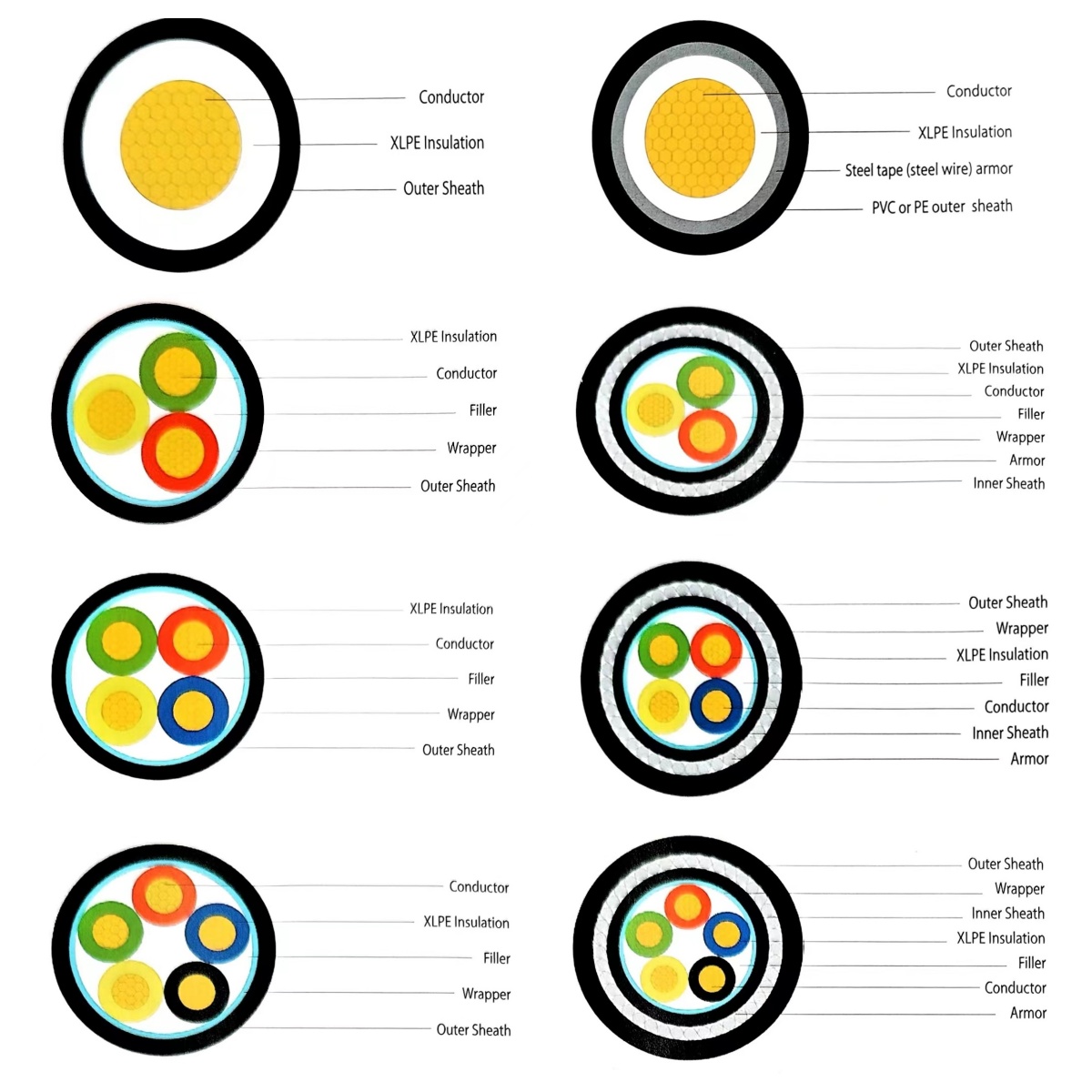
This series of cables all adopt a four-core structure. This design is to meet the needs of three-phase four-wire power supply, ensuring the stability and safety of the power supply system. One of the cores is specially used as a
Grounding Wire. When the equipment has faults such as electric leakage or short circuit, it can quickly conduct the current to the ground, avoiding electric shock accidents and providing an important guarantee for outdoor electricity safety. The arrangement of the four cores is optimized to ensure the compactness of the cable and facilitate installation and maintenance.
In addition, the insulation resistance of the cable is also an important specification parameter. Under standard conditions, the insulation resistance of this series of cables can reach more than the specified value, ensuring that the cable has good insulation performance, effectively preventing current leakage, reducing power loss, and avoiding safety accidents caused by poor insulation. The voltage withstand performance of the cable has also been strictly tested, which can withstand a certain voltage impact, operate stably within the normal working voltage range, and adapt to possible voltage fluctuations in the outdoor power grid.
(2) Characteristic Applications
Aluminum Power Cables (10mm², 16mm², 25mm², 35mm², 240mm²) have irreplaceable characteristic applications in many outdoor scenarios due to their various specifications and excellent performance.
In the field of municipal engineering, this series of cables plays an important role. 10mm² and 16mm² cables are widely used in the street lamp power supply system on both sides of the road. Road street lamps are widely distributed, and have high requirements for cable laying. These two specifications of cables have small diameters, which are more convenient to lay, and their current-carrying capacity can meet the power needs of street lamps. At the same time, they are also suitable for traffic signal systems. Traffic signals need stable power supply to ensure normal operation and road traffic safety and order. The stability and reliability of these two cables can meet their requirements.
25mm² and 35mm² cables are commonly used in landscape lighting and background music systems in public areas such as parks and squares. Landscape lighting is usually composed of multiple lamps, distributed in various corners of parks and squares, requiring cables to have a certain current-carrying capacity and good weather resistance. 25mm² and 35mm² cables can just meet these needs, ensuring that landscape lamps light up normally at night and create a beautiful night environment. The power of background music system equipment is moderate, and these two specifications of cables can provide stable power for it, allowing people to enjoy comfortable music during leisure and entertainment. In addition, the power transmission of outdoor charging piles is also inseparable from 25mm² and 35mm² cables. With the popularization of new energy vehicles, the number of outdoor charging piles is increasing, and the requirements for power transmission are also increasing. These two cables can ensure that charging piles charge vehicles quickly and safely.
The agricultural field is another important application scenario for this series of cables. 35mm² cables can be connected to field irrigation equipment. Agricultural irrigation equipment needs continuous power to drive devices such as water pumps to ensure the growth needs of crops. The current-carrying capacity of 35mm² cables can meet their power requirements, and they have strong weather resistance and can adapt to the complex environment in the field. In greenhouses, the temperature control system is highly dependent on electricity. 35mm² cables can provide stable power for temperature control equipment, ensuring that environmental parameters such as temperature and humidity in the greenhouse remain within the range suitable for crop growth. 240mm² cables provide power support for large agricultural transformers and power equipment in farms. Large agricultural transformers are important hubs of the agricultural power system and require strong power transmission capacity. Power equipment in farms, such as feed processors and ventilation equipment, have large power. The high current-carrying capacity of 240mm² cables can meet the power needs of these equipment, ensuring the smooth progress of agricultural production.
In outdoor temporary construction, this series of cables also performs well. Small 规格 cables such as 10mm² and 16mm² can be used as temporary transmission lines to supply power to small construction tools such as hand drills and cutting machines; 25mm² and 35mm² cables can provide power to medium-sized construction equipment such as mixers and electric welders; 240mm² cables can meet the power needs of large construction machinery such as excavators and cranes. The portability and durability of these cables enable them to be quickly deployed and used in temporary construction, effectively improving construction efficiency and ensuring that construction projects are completed on time.
(3) Material and Style
Aluminum Power Cables (10mm², 16mm², 25mm², 35mm², 240mm²) fully consider the special environment of outdoor use in material selection and style design, showing excellent performance and practicality.
The conductor is made of high-purity aluminum material with a purity of more than 99.5%. High-purity aluminum not only ensures good conductivity, enabling it to effectively reduce energy loss during power transmission and improve transmission efficiency, but also, compared with copper, aluminum has a smaller density, which greatly reduces the weight of the cable. This feature is particularly important in
Outdoor Cable erection, reducing the load pressure during erection, lowering installation difficulty and cost, and also reducing the load requirements on the erection 支架. In addition, aluminum has strong corrosion resistance, and is not easy to be corroded and damaged in humid and dusty outdoor environments, and can maintain stable performance for a long time, extending the service life of the cable.
The outer sheath is made of PVC (polyvinyl chloride) material, which is an important guarantee for the cable's protective performance. The
PVC Sheath has excellent weather resistance and can maintain stable performance in the temperature range of -20℃ to 60℃. It can work normally in both cold winters and hot summers, without being affected by extreme temperatures. Its UV aging resistance is also very excellent. When exposed to sunlight for a long time, it will not easily crack or harden, ensuring the effective protection of the inner conductor by the sheath. At the same time, PVC material has good waterproof performance, which can effectively block water such as rain and dew from entering the cable, avoiding the conductor from getting damp and affecting conductivity or causing short-circuit faults. Moreover, PVC also has acid and alkali corrosion resistance, and can adapt to outdoor possible acid and alkali environments, such as near chemical plants and farmland irrigation areas, protecting the cable from chemical erosion.
In terms of style, this series of cables adopts a four-core tightly stranded structure design. This structure not only enhances the
Flexibility of the cable, enabling it to be flexibly bent and laid in complex outdoor terrain, such as bypassing obstacles and passing through pipes, reducing obstacles in the installation process, but also the stranding method makes the four cores an integral whole, improving the mechanical strength of the cable, enhancing its tensile and impact resistance, and better resisting external forces during outdoor construction or use.
The appearance color of the cable is usually dark colors such as black or gray. This color choice helps reduce sunlight reflection, lowering the temperature rise of the cable in sunlight, and at the same time, it can better integrate with the outdoor environment, reducing visual 突兀感. The surface of the cable is printed with clear marks, including product model, cross-sectional size, rated voltage, manufacturer and other information. These marks not only facilitate users to identify and select suitable cables, but also provide convenience for cable installation, maintenance and management.
(4) Production Process
The production process of aluminum power cables (10mm², 16mm², 25mm², 35mm², 240mm²) is complex and rigorous, and each link is strictly controlled to ensure that the product quality meets the high standards of outdoor use.
Aluminum ingot smelting is the first step in production. High-purity aluminum ingots are selected as raw materials and put into a smelting furnace for heating and smelting. During the smelting process, it is necessary to accurately control the temperature, generally around 700℃, and at the same time, carry out impurity removal treatment on the aluminum liquid to remove impurities and gases in it to ensure the purity of the aluminum liquid. The impurity removal treatment usually uses a refining agent. By stirring, the refining agent is fully contacted with the aluminum liquid, adsorbing impurities and floating to the surface to be removed. The smelted aluminum liquid is left to stand, and then cast into aluminum rods through casting equipment. The quality of the aluminum rods directly affects the performance of subsequent conductors, so it is necessary to strictly control the casting speed and cooling method to ensure that the structure of the aluminum rods is uniform and dense.
Next is the aluminum rod wire drawing process. The aluminum rod is drawn into
Aluminum Wires of the required diameter through a wire drawing machine. During the wire drawing process, the aluminum rod passes through a series of dies of different specifications and is gradually drawn to the target diameter. The wire drawing speed, die lubrication and cooling conditions need to be accurately controlled to ensure that the
Aluminum Wire has a uniform diameter, smooth surface, and good mechanical properties and conductivity. For cables of different cross-sectional sizes, the required diameter and number of aluminum wires are different. For example, 10mm² cables may be stranded by multiple thinner aluminum wires, while 240mm² cables require more or thicker aluminum wires.
Aluminum wire stranding is a key step in forming conductors. According to the cross-sectional size requirements of the cable, multiple aluminum wires are stranded together in a certain stranding way to form the required conductor. There are regular stranding, bunch stranding and other stranding methods. Different stranding methods will affect the flexibility and filling coefficient of the conductor. During the stranding process, it is necessary to ensure that the tension of the aluminum wires is uniform and the stranding pitch is consistent to ensure the roundness and structural stability of the conductor, and avoid conductor loosening or uneven stress in subsequent processes.
After the conductor is formed, the insulation layer is extruded. The insulating material (usually polyethylene or cross-linked polyethylene) is added to the extruder, heated and melted, and then uniformly coated on the surface of the conductor through a die to form an insulation layer. The thickness of the insulation layer is determined according to the voltage level and use environment of the cable. It is necessary to accurately control the extrusion temperature, pressure and speed to ensure that the insulation layer has a uniform thickness, smooth surface, and is closely combined with the conductor, without bubbles, impurities and other defects. The quality of the insulation layer is directly related to the insulation performance of the cable, so it must undergo strict testing.
Subsequently, the cabling process is carried out. Four conductors with insulation layers (one of which is a grounding wire) are cabled according to a certain stranding direction and pitch. During the cabling process, in order to ensure the roundness and structural stability of the cable, some filling materials, such as polypropylene ropes, are filled between the conductors. The selection of filling materials should consider their weather resistance and chemical stability to adapt to the outdoor environment. After cabling, it is also necessary to wrap a layer of wrapping tape on the outside to fix the cabled structure and prevent the conductors from loosening.
Finally, the sheath is extruded. PVC material is added to the extruder, heated and melted, and then coated on the outside of the cabled core through a die to form the outer sheath. The process requirements for sheath extrusion are similar to those for the insulation layer. It is necessary to strictly control various parameters to ensure that the sheath has a uniform thickness, flat surface, is closely combined with the core, and has good sealing performance. After the sheath extrusion is completed, the cable also needs to undergo cooling, traction and other treatments to shape it.
During the entire production process, multiple quality inspection procedures are required. From the inspection of raw materials, to the inspection of semi-finished products in each process, to the performance testing of finished cables, such as conductor resistance, insulation resistance, voltage withstand performance, mechanical performance, etc., to ensure that each batch of cables meets relevant standards and technical requirements. Only cables that pass strict inspection can leave the factory and be put into use.
II. From the Perspective of General Product Information
(1) Packaging
The packaging design of aluminum power cables (10mm², 16mm², 25mm², 35mm², 240mm²) fully considers the characteristics of the product and the needs of transportation and storage, aiming to protect the cable from damage during the entire circulation process and ensure the quality and performance of the product.
For coiled cables, wooden cable reels are usually used for packaging. Wooden cable reels have the characteristics of high strength and good stability, and can provide solid support for the cables. The size of the cable reel is designed according to the length and cross-sectional size of the cable. For example, small 规格 10mm² and 16mm² cables can use cable reels with smaller diameters, while large 规格 240mm² cables require cable reels with larger diameters to ensure that the cables can be neatly wound on them, avoiding twisting, folding or loosening. When winding the cable, it is necessary to control the winding tension to make the cable arranged tightly, reducing shaking and friction during transportation and preventing the cable sheath from being worn.
The two sides of the cable reel are equipped with solid baffles, and the height of the baffles is higher than the winding height of the cable to prevent the cable from slipping during transportation and handling. The thickness and material of the baffles are strictly selected to ensure that they have sufficient strength to withstand the weight of the cable and the impact force during transportation. Metal hooks or holes are usually installed on the baffles to facilitate handling with forklifts, cranes and other equipment, improving handling efficiency and avoiding damage to the cable during handling.
A detailed label is pasted on the side of the cable reel, which clearly indicates the product name, model specification (such as 10mm², 16mm², etc.), length, rated voltage, production batch number, production date, implementation standard, manufacturer name and contact information, etc. This information not only facilitates users to identify and accept the product, but also provides convenience for product traceability and quality tracking. For exported cables, the information on the label also needs to be translated into the corresponding foreign language to meet the requirements of the international market.
In order to prevent the cable from getting damp and contaminated during storage and transportation, the outer layer of the cable is wrapped with a moisture-proof and dust-proof plastic film. The plastic film should be closely attached to the surface of the cable without gaps, which can effectively block moisture, dust, impurities, etc. from entering the cable, protecting the insulation layer and conductors of the cable from damage. For cable reels with long length and heavy weight, steel strips are used to firmly fix the cable on the cable reel. The tightening force of the steel strips should be moderate, which should ensure that the cable does not loosen and not excessively squeeze the cable, so as not to damage the sheath and insulation layer of the cable.
During storage, packaged cables should be stored in a dry, ventilated, dark warehouse away from heat sources and corrosive substances. The cable reel should be placed on a flat ground and padded with wooden blocks to keep a certain distance between the cable reel and the ground, preventing the cable reel from getting damp due to direct contact with the ground. At the same time, it is necessary to avoid stacking heavy objects on the cable reel to prevent the cable from being crushed and affecting its performance.
(2) Transportation
The transportation process of aluminum power cables (10mm², 16mm², 25mm², 35mm², 240mm²) needs to strictly follow relevant regulations and operating procedures to ensure the safety and integrity of the cable and avoid product damage due to improper transportation.
Before transportation, a comprehensive inspection of the cable packaging is required. Carefully check whether the cable reel is firm, whether the baffle is intact, whether the cable is wound neatly and tightly, whether the label is clear and complete, and whether the plastic film is well sealed. If any damage or looseness is found in the packaging, it should be repaired or repackaged in a timely manner until it meets the transportation requirements. For cables of different specifications, appropriate transportation tools and loading and unloading equipment should be selected according to their weight and size to ensure the safety of the transportation process.
According to the specifications, quantity and transportation distance of the cables, appropriate transport vehicles are selected. Ordinary trucks can be used for short-distance transportation, while semi-trailers or special transport vehicles are more suitable for long-distance transportation. The carriage of the transport vehicle should be kept clean and flat, without sharp debris, to prevent scratching the cable packaging and sheath. When loading the cable, a forklift or crane is used to lift the cable reel smoothly into the carriage. During the lifting process, collision and extrusion of the cable reel should be avoided to prevent deformation of the cable reel or loosening of the cable. The cable reels should be placed reasonably in the carriage to ensure a stable center of gravity. Usually, the central axis of the cable reel is consistent with the driving direction of the vehicle to reduce the impact of centrifugal force during transportation.
In order to prevent the cable reel from rolling and colliding during transportation, it is necessary to firmly fix it in the carriage with steel wire ropes or chains. The fixed points should be selected on the special fixing devices of the vehicle. The tension of the steel wire ropes or chains should be moderate, which should ensure that the cable reel does not move and not be over-tightened to damage the cable reel or cable. For simultaneous transportation of multiple cable reels, a certain gap should be left between the cable reels, and partitions should be used to separate them to avoid mutual friction and collision, resulting in wear of the cable sheath or structural damage.
During transportation, drivers must strictly abide by traffic rules, maintain stable driving, avoid violent operations such as sudden braking, sharp turns and speeding, and reduce the impact and vibration on the cable. When passing through bumpy sections, bridges, tunnels and other special sections, drive slowly to ensure driving safety and cable stability. At the same time, attention should be paid to protecting the cable from severe weather. In case of rain or snow, the cable should be covered to prevent it from getting damp; in hot weather, the cable should be avoided from being exposed to the sun for a long time to prevent the sheath from aging due to high temperature.
Special personnel should be arranged for escort during transportation. The escorts should be familiar with the characteristics and transportation requirements of the cable, regularly check the fixing status and packaging of the cable, and deal with problems in a timely manner. If transportation is delayed due to traffic jams, road maintenance, etc., the recipient should be informed in time of the expected arrival time.
After arriving at the destination, appropriate equipment should be used to unload the cable reel from the carriage smoothly. During unloading, collision and extrusion of the cable should be avoided. After unloading, the escorts and the recipient should jointly inspect the packaging, appearance and labels of the cable. After confirmation, the handover procedures should be handled.
(3) Delivery
The delivery process of aluminum power cables (10mm², 16mm², 25mm², 35mm², 240mm²) is standardized and efficient, ensuring that products are delivered to customers accurately and on time.
Upon receiving a customer's order, the sales department promptly verifies all details. This includes confirming the product specifications (such as 10mm², 16mm², etc.), quantity, delivery address, requested delivery date, and contact information. Any ambiguities or discrepancies in the order are immediately clarified with the customer to prevent errors in delivery.
Once the order is confirmed, the sales department transmits the order details to the warehouse. Warehouse staff retrieve the corresponding cables from inventory, adhering to the first-in-first-out principle to ensure products are within their shelf life. They conduct a thorough inspection of the retrieved cables, checking for intact packaging, clear labeling, and that the specifications match the order requirements.
After passing inspection, the cables are prepared for shipment. They are securely packaged according to the specified standards to withstand transportation. The warehouse then generates a delivery note, which includes comprehensive information such as product details, customer information, and shipping instructions. This note is handed over to the logistics team along with the products.
The sales department coordinates with logistics companies to arrange suitable transportation based on the delivery schedule and destination. They provide the logistics provider with all necessary shipping details, including pickup and delivery addresses, contact persons, and contact information, to ensure a smooth pickup and delivery process.
Once the shipment is dispatched, the customer is promptly notified with details such as the logistics company name, vehicle license plate number, driver's contact information, waybill number, and estimated arrival time. This allows the customer to prepare for receipt. The sales team also tracks the shipment's progress, maintaining communication with both the logistics provider and the customer to address any issues that may arise during transit.
For customers with special delivery requirements, such as expedited shipping or specific delivery time windows, the sales department works closely with the warehouse and logistics partners to accommodate these needs, ensuring the products arrive as requested.
(4) Samples
To help customers make informed purchasing decisions, the company offers sample services for aluminum power cables (10mm², 16mm², 25mm², 35mm², 240mm²), allowing them to evaluate the product's quality and performance firsthand.
Customers can request samples through various channels, including phone, email, online inquiries, or on-site visits. When making a request, customers specify the desired specifications, the purpose of the sample (e.g., performance testing, project demonstration), quantity needed, and provide contact information and delivery address.
Upon receiving a sample request, the sales department reviews it promptly. For standard requests that meet the criteria, the department confirms details with the customer and arranges for the warehouse to prepare the samples. For special requests, such as samples with specific lengths or custom markings, the sales team collaborates with the production department to assess feasibility and informs the customer of the timeline and any associated considerations.
The warehouse selects qualified products from inventory based on the sample request, conducting rigorous inspections to ensure the samples match the quality and performance of bulk products. Samples are then packaged securely to prevent damage during transit, with accompanying product information and company brochures to assist the customer in their evaluation.
The company selects appropriate shipping methods based on the customer's location and urgency, such as express delivery for domestic customers (ensuring delivery within a few days) or international courier services for overseas clients to minimize transit time. After shipment, the customer is provided with the waybill number and tracking information to monitor the sample's progress.
Customers can conduct various tests on the samples, including checking appearance, measuring conductor diameter and insulation thickness, and testing insulation and mechanical properties. Technical support is available throughout the evaluation process, with the company's technical or sales staff providing professional guidance and answering any questions.
Sample services are typically free of charge, though shipping costs may be borne by the customer or negotiated. For customers who place subsequent orders, the company may refund shipping costs as per agreement, fostering trust and facilitating potential collaborations.
(5) After-sales Service
The company places great emphasis on after-sales service for aluminum power cables (10mm², 16mm², 25mm², 35mm², 240mm²) and has established a comprehensive system to provide timely and effective support.
Warranty coverage is a key component of after-sales service. The products come with a warranty period, typically 1-3 years from the delivery date, varying by model and application. During this period, if the cable experiences quality issues (e.g., insulation breakdown, conductor failure, sheath cracking) due to manufacturing defects or material flaws under normal use, customers can claim warranty service. Customers must provide proof of purchase, product model, batch number, and a description of the issue. Upon receiving a claim, the company dispatches technical personnel to verify the problem. If confirmed as a covered defect, the company offers free repair, replacement, or other solutions to restore the customer's power system promptly.
For issues beyond the warranty period or caused by improper use, damage, or force majeure, the company provides paid maintenance services. Customers contact the after-sales department to describe the problem, and staff evaluate repair feasibility, providing a plan and cost estimate. Repairs use genuine parts, and a warranty is offered for repaired components.
Technical support is another vital aspect. A team of experienced engineers provides guidance on product selection, installation, laying, operation, and maintenance. Support is available via phone, email, online communication, or on-site visits. For example, technical staff recommend suitable specifications based on load and environment, or offer solutions for cable joint handling and mechanical damage prevention during installation.
Regular customer follow-ups are conducted via phone, email, or site visits to assess product performance and gather feedback. Key customers or large projects receive dedicated on-site inspections to identify potential issues and provide preventive maintenance advice. Feedback is analyzed to continuously improve product quality and service.
Additionally, a 24/7 after-sales hotline and online platform address inquiries and complaints. Staff respond promptly, ensuring each issue is tracked until resolution, enhancing customer satisfaction.


 English
 Español
 Portugues
 Pусский
 Français
 ไทย
ไทย Türk dili
 Indonesia
 Tiếng Việt



 هاتف
هاتف صندوق البريد